The Illusion of the Static Fit
A saddle can appear correct on a standing horse and still become restrictive the moment the horse walks, collects, or reaches forward. This is the central weakness of many fitting routines built around a static 2D wither tracing. The tracing records one outline, usually taken while the horse is square, relaxed, and unloaded. It does not show how the scapula rotates, how the thoracic muscles expand, or how the horse’s back changes when a rider, girth, and working posture are added.
Color-coded interchangeable gullet bars can make saddle selection look precise, but a gauge primarily describes horizontal width at a particular point. It does not automatically describe the angle of the tree points, their length, their flare, or their relationship with the ribs behind the scapula. A wider plate may create more room at the pommel while allowing the saddle to drop lower onto the withers, producing pressure where the measurement was intended to prevent it. For practical guidance on assessing shoulder shape, a specialist resource such as this guide to saddle fitting for uneven shoulders is useful because it treats asymmetry as a fitting problem rather than a simple width category.
Natural bilateral asymmetry is common in horses. One shoulder may carry more muscle, one scapula may sit slightly differently, or a horse may develop unevenly after injury, compensation, or years of one-sided training. The standing horse can conceal these differences beneath muscle and skin. The working horse cannot. True fit depends on whether the tree points remain clear of the moving shoulder and whether the saddle stays stable without forcing the rider or horse into compensation. Gullet measurement matters, but tree point angle, shoulder clearance, and dynamic balance matter more.
The Biomechanics of Scapular Rotation Under Saddle
The scapula is not a fixed plate lying passively beneath the saddle. It is suspended against the thorax by muscle and connective tissue, with the scapular cartilage extending the functional surface upward and backward. During protraction, when the forelimb reaches forward, the scapula rotates upward and backward relative to the trunk. During retraction, it returns through the opposite phase of the stride. The visible shoulder point is therefore only one landmark in a moving system.
This movement takes place beneath the front of the saddle, where rigid tree points, the front of the panels, and the girth can all influence available space. The trapezius muscle bed is particularly important because it helps suspend and move the shoulder region while also contributing to the shape that supports the saddle. Sensory and motor nerve structures travel through the neck and shoulder region, while the brachial plexus and associated tissues lie near the base of the neck and forelimb. A saddle that repeatedly compresses the muscle bed can contribute to guarding, shortened reach, altered posture, and resistance, even when the horse shows no obvious reaction during a brief static check.
A standing measurement also misses the difference between a horse carrying the forelimb underneath the body and one extending it forward. In collection, the thoracic sling and back muscles engage, changing the contour under the front arch. In extension, the scapula needs room to rotate and translate without meeting a rigid obstruction. The tree must therefore provide clearance through the movement arc, not merely a gap over the withers at halt.
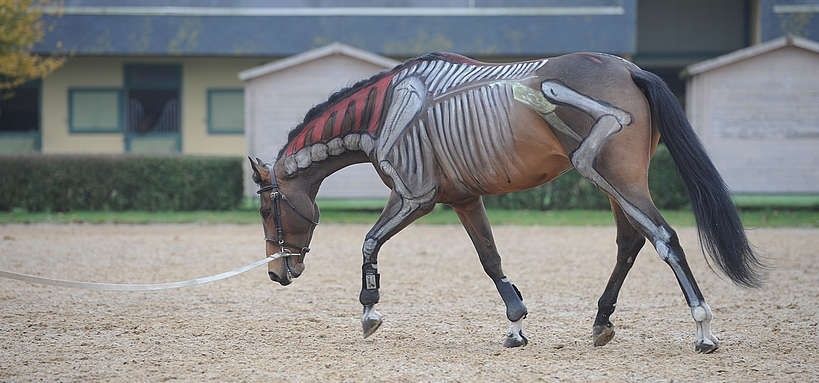
- Scapular rotation requires space behind and below the front of the tree points.
- Muscle expansion changes the contact surface under work, especially when the horse lifts the thorax.
- A static tracing cannot reveal whether the saddle bridges into the moving shoulder.
- Clearance should be checked with the saddle fitted, girthed, and observed in motion.
Why Bilateral Asymmetry Knocks Standard Saddles Off Track
When one shoulder is larger or more developed, a symmetrical tree does not simply sit slightly off-centre. The larger shoulder can meet the nearer tree point earlier in the stride and exert a lateral and backward force on the saddle. The saddle head is pushed away from that shoulder, while the opposite side may lose consistent contact. Under a rider, this effect becomes more pronounced because the rider’s weight increases friction and pressure at the point where the tree is already being displaced.
The result is often a saddle that rolls or drifts toward the smaller shoulder. The rear panels may twist in response, creating a diagonal pressure pattern rather than an even bearing surface. Riders commonly interpret this as a crooked seat, an uneven leg, or a tendency to collapse through one hip. Those observations may be correct, but they can also be consequences of the saddle being displaced by the horse’s shoulder mechanics. A rider cannot reliably correct a moving saddle with posture alone.
Over time, the horse may develop hollowed pockets behind the smaller shoulder because the saddle has failed to maintain useful contact there, while the larger side receives excessive loading. The back can then become sore farther behind the saddle as the horse braces through the thoracolumbar region to avoid the unstable pressure at the front. In performance horses, the signs may be subtle: reduced reach in one rein, reluctance to lift the withers, a shorter phase of suspension, or a rider who feels consistently pushed to one side.
| Structural pattern | Likely mechanical effect | Fitting priority |
|---|---|---|
| Larger dominant shoulder | Pushes the saddle away and encourages roll toward the smaller side | Protect the larger shoulder with suitable point angle and clearance |
| Smaller or hollowed shoulder | Creates a contact deficit and unstable panel support | Restore even contact with controlled flocking or shims |
| Uneven rib or thoracic contour | Changes how the panels bear weight behind the scapula | Assess panel symmetry independently from gullet width |
| Muscular asymmetry from training or injury | May change as movement and conditioning improve | Use adjustable materials and schedule repeat assessments |
Gullet Plate Width Versus Tree Point Angle
Gullet plate width and tree point angle answer different questions. Width describes the distance across the front of the saddle, often considered in relation to the withers. Tree point angle describes how the points descend and lie alongside the horse’s rib cage. A saddle can have an apparently generous gullet opening and still be too steep at the points. Conversely, a saddle with a suitable point angle can appear less wide at the pommel while distributing pressure more correctly along the shoulder line.
Simply widening a standard gullet plate can make the pommel look more open, but it may also lower the front of the saddle. The tree then descends closer to the lower wither and upper rib area, where the horse needs room for scapular rotation. If the points are too steep or too long, the plate change has solved the visible measurement while worsening the functional restriction. This is why a saddle should be assessed as a complete structure: tree shape, point design, panel depth, flocking, and rider balance must work together.
In a workshop assessment, the saddle fitter should compare the direction of the tree points with the slope of the shoulder and ribs, then repeat that observation while the horse walks and reaches. The aim is not for the points to clamp against the shoulder, nor for them to float so far away that the front becomes unstable. The points should remain parallel or appropriately aligned with the horse’s shape, with sufficient freedom for the scapula to pass beneath the forward edge of the panel. This is a hands-on judgement that a colour label cannot replace.
- Check the pommel opening without treating it as a complete width measurement.
- Trace the angle of each tree point down the shoulder, not just across the withers.
- Observe the saddle during walking, transitions, and forelimb extension.
- Assess whether panel contact remains broad and even after the rider mounts.
Workshop Protocols for Accommodating the Asymmetrical Equine Back
Asymmetrical fitting should begin with the horse, not with a box of gullet plates. The fitter must determine whether the difference is skeletal, muscular, postural, or movement-related. A horse recovering from discomfort may stand unevenly or brace through one side, while a trained horse may show a pronounced difference in muscle development that changes with conditioning. Professional evaluation is important because the wrong shim or a poorly placed flocking adjustment can create a new pressure point.
A useful protocol combines palpation, gait observation, saddle inspection, and rider feedback. The goal is not to make the horse look artificially symmetrical. The goal is to give the larger moving structures enough space while supporting the areas that have lost contact. Adjustable panels, independently flockable sections, and carefully selected shim systems can often manage this more effectively than repeated gullet swaps.
- Begin with dynamic palpation and gait assessment. Palpate both shoulders, the trapezius region, withers, back, and lumbar area before fitting tools are used. Observe the horse at walk and trot, ideally in both directions, and note differences in forelimb reach, thoracic lift, back swing, and rider position. The saddle should then be watched during movement rather than judged only while the horse is standing.
- Fit the tree to the larger, dominant shoulder. The larger shoulder is the side most likely to meet and displace a symmetrical tree. Selecting an appropriate tree point angle and length prevents the saddle from impinging on the dominant side. This does not mean leaving the smaller side unsupported. It means avoiding a basic tree shape that is already too restrictive where movement is greatest.
- Balance the deficit on the weaker side. Once the tree is clear and stable, use targeted flocking or a suitable shim system to restore contact on the smaller side. Support should be broad, controlled, and checked under load. Packing a thick pad into the front of the saddle without correcting the underlying geometry can lift the saddle unevenly or push it back into the larger shoulder.
- Reassess at roughly three-month intervals. Muscular asymmetry can change with rehabilitation, training, pain resolution, workload, and seasonal condition. Repeat checks should include photographs, palpation, movement assessment, sweat patterns, rider balance, and signs of soreness. A fit that was correct after a period of rest may need adjustment after a new conditioning programme.
Dynamic checks should be repeatable and practical. For example, a movement-based clearance check can be performed with the saddle girthed while the horse walks, while the fitter observes whether pressure at the front changes as the back engages. The exact clearance requirement depends on the saddle’s construction, but the principle remains consistent: the saddle must not create focal pressure as the horse moves. A useful reference for movement-based checking is the SMART saddle fit guidance, which describes checking clearance and pressure while the horse is walking rather than relying only on halt.
Building Balanced Motion Through Dynamic Saddle Architecture
True saddle fit is not a number printed on a gullet bar. It is the relationship between a particular tree, a particular horse, a particular rider, and the movement demanded by the work. Static tracings remain useful as one record of shape, and interchangeable plates can be useful within their limits, but neither tool captures the full mechanics of scapular rotation, muscle expansion, asymmetrical loading, and rider influence.
The master saddler’s most important task is to diagnose tree point parallelism and dynamic shoulder clearance, then use panel construction to create stable, even support. Riders should request a reassessment when the saddle drifts consistently in one direction, the pommel changes height after mounting, one shoulder loses reach, sweat marks become uneven, or the horse develops sensitivity behind the shoulder or through the lumbar region. These signs do not identify one cause on their own, but they justify a careful professional examination.
- Watch for one-sided saddle roll, twist, or repeated girth displacement.
- Check whether the larger shoulder shows restricted reach or guarding.
- Do not treat a wider gullet plate as a substitute for correct tree point angle.
- Use shims or flocking to balance contact only after the basic tree is suitable.
- Repeat the assessment as the horse’s musculature and training change.
When saddle architecture follows the horse’s moving anatomy, the rewards extend beyond comfort at the mounting block. The horse can reach through the shoulder, lift the thorax, and use the back without defending against a rigid obstruction. The rider receives a more stable platform and can correct their own balance without fighting saddle drift. That is the practical standard worth pursuing: soundness, uninhibited movement, and a balanced partnership built on fit before fashion.