The Workshop Truth About What Sits Between You and Your Horse
In a saddlery showroom, panel materials are often reduced to simple promises: wool is traditional, foam is modern, and air is clever. The working reality is less tidy. A panel is a load-bearing component that must manage the repeated forces of trot and canter while remaining compatible with the horse”s changing back, the rider”s balance, and the saddle”s tree. For a closer look at saddle panel maintenance, the important question is not which material sounds most advanced, but how it behaves after months of real work.
Panel cushioning influences pressure distribution, spinal clearance, thermal exchange, and the degree to which the saddle remains stable during movement. A panel that feels comfortable when standing still may behave very differently once the horse lifts its back, the rider sits a diagonal, and thousands of impact cycles begin to accumulate. The three principal contenders are long-fiber wool flocking, molded latex or other engineered foam, and sealed air bladders. Each has a useful mechanical profile, but each also has failure modes that must be understood before purchase. The importance of evaluating performance under repeated load rather than relying on initial appearance is also illustrated by the Comparison of incisional bursting strength of 2-strand continuous crossing and simple continuous patterns for closure of the equine linea alba, albeit in a different equine tissue context.
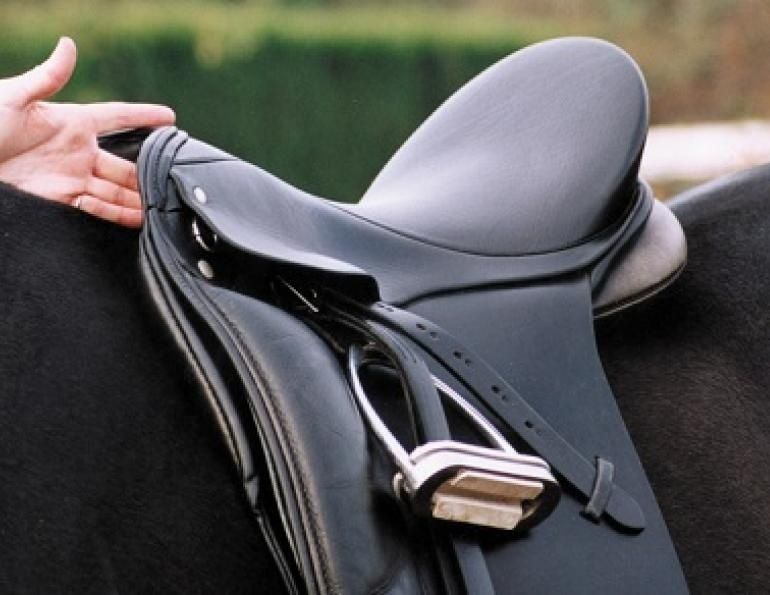
Mechanical Compression Fatigue and Long-Term Load Bearing
Long-fiber wool is not a static cushion. Under repeated loading, its fibers compress, migrate, and settle into the horse”s individual contours. That capacity is one of its greatest advantages because a qualified saddler can add, remove, or redistribute flocking as the horse develops. It is also the reason wool demands inspection. If neglected, compressed fibers can form hard areas, uneven channels, or a compacted ridge that creates bridging, rocking, or a loss of shock absorption. In practical terms, wool often gives useful warning through visible sweat patterns, altered balance, or a changed feel beneath the saddle before the problem becomes severe.
Foam behaves differently. Closed-cell foam is dense, water-resistant, and designed to retain its shape under load, while open-cell foam generally offers more softness and air movement but may collapse or bottom out when heavily compressed. Latex and other performance foams can provide useful shape memory and consistent pressure distribution, yet micro-cellular breakdown may progress gradually without an obvious external defect. A foam panel can look intact while losing resilience. Repeated trot landings then become less effectively damped, particularly when the foam has been exposed to heat, sweat, compression, and age.
Air bladders do not develop the same internal compression set as wool or foam. Their volume remains broadly stable until the bladder, valve, or surrounding construction fails. However, air does not automatically absorb impact. It transmits force through pressure changes within the sealed chamber, and the response depends heavily on inflation level, bladder geometry, and how the air is divided. Excess pressure can produce a lively, unstable rebound that feels like a trampoline, while insufficient or uneven pressure may allow the saddle to move or create localized loading. Biomechanical research on repetitive mechanical stress, including this biomechanical study of saddle pressure distribution and loading and the Authoritative Source, reinforces the importance of evaluating repeated dynamic force rather than relying on a static impression.
| Panel system | Strength under repeated work | Typical risk | Maintenance profile |
|---|---|---|---|
| Long-fiber wool | Gradual contouring and adjustable support | Compression, migration, and hard spots | Regular inspection, adjustment, and eventual reflocking |
| Foam | Stable shape and consistent initial distribution | Cell fatigue, heat retention, bridging, or rebound | Low routine adjustment, but replacement may be substantial |
| Air bladder | No conventional internal compaction | Over-inflation, leakage, rupture, or shock transmission | Pressure checks and specialist repair when required |
Thermoregulation and Sweat Management on the Dynamic Back
Heat is not a cosmetic concern. During work, the dorsal muscles are contracting, lengthening, and stabilizing the rider while the saddle and panel press against the skin. Wool has a practical advantage because its fibers can absorb and move moisture while retaining a degree of breathability. That does not make wool immune to sweat damage. Salt and moisture can stiffen fibers, affect the panel covering, and contribute to leather deterioration if the saddle is stored damp or not cleaned correctly.
Dense foam, particularly closed-cell foam, can act as a thermal insulator. It may remain mechanically stable while holding heat against the back, especially when combined with a thick, poorly ventilated pad. Open-cell structures may offer better airflow, but softness alone does not guarantee effective heat management. Air bladders also create a barrier between the horse and the outside environment. The enclosed air warms rapidly toward body temperature, but there is no natural wicking route through the bladder itself, so sweat must be managed by the pad, panel covering, and grooming routine.
Localized heat often accompanies friction and uneven pressure. A hot, dry patch beneath one part of the panel may indicate restricted circulation or excessive contact, while unusually wet areas can signal concentrated loading and increased muscular effort. Research examining equine back pain and saddle pressure distribution, including this clinical study of saddle-related back problems, highlights why pressure and comfort must be assessed together rather than separately.
- Use a breathable, correctly sized pad rather than adding bulk to disguise poor fit.
- Inspect sweat patterns after work, but interpret them alongside palpation and a ridden assessment.
- Allow leather and panel coverings to dry fully before storage, away from direct high heat.
- Watch for persistent dry spots, scurf, rubs, or heat that remains after the horse has cooled.
Real-World Adjustability as Muscle Profiles Develop
Wool remains the most workshop-friendly option when a horse”s shape is changing. Through inspection slits, a saddler can add flocking to support a hollow, remove excess from a tight area, or shift material to correct asymmetry. This is particularly useful for young horses, horses returning from injury, and animals whose toplines change with training. The work is precise rather than cosmetic. A small alteration at the rear panel or behind the shoulder can change balance, clearance, and the way the tree contacts the back.
Fixed foam panels offer fewer opportunities for local correction. If the horse gains or loses muscle, or if rehabilitation changes the shape behind the shoulder, a rigid foam profile may no longer follow the back. Shimming can sometimes address a minor, temporary discrepancy, but thick or uneven shims may alter the saddle”s balance and create new pressure points. Air systems appear highly adjustable, yet pneumatic adjustment is not automatically better. Over-inflation can create excessive rebound and a raised, unstable feel, while unequal air pressure can shift the saddle from side to side.
- Start with the horse. Check for heat, swelling, tenderness, muscle loss, white hairs, rubs, or reluctance to lift the back.
- Inspect the saddle off the horse. Look for panel symmetry, distorted coverings, broken stitching, leaking valves, or foam that feels permanently flattened.
- Check static contact. Confirm that the panels contact evenly, the saddle does not rock, and there is no obvious bridging through the middle.
- Assess movement. Watch the horse in walk, trot, and the discipline-specific work. Observe slipping, lifting panels, shortened stride, resistance, or changes in rider balance.
- Book bench service when needed. A professional should decide whether the answer is reflocking, a controlled shim, air-pressure correction, panel repair, or a different saddle.
Workshop Decision Matrix for Riders and Equine Athletes
The sensible choice depends on the horse, not on the material”s reputation. Wool suits owners who value local adjustment and can commit to regular inspections. It is especially useful where the horse is still developing, where asymmetry changes with training, or where a skilled fitter is readily available. Its lower initial cost can be offset by periodic adjustments and complete reflocking, often recommended at intervals of roughly one to two years depending on workload and condition.
Foam may suit a mature horse with a stable topline and a rider who wants consistent geometry with limited routine maintenance. Air can be valuable where controlled pressure adjustment is genuinely understood and monitored, but it should not be treated as a maintenance-free solution. Before investing, ask a qualified fitter:
- How will the panels accommodate this horse”s expected muscle changes?
- What signs will show that the material is losing resilience or creating uneven pressure?
- Can the system be adjusted locally, or does it require a complete rebuild?
- How often should the saddle be assessed under ridden conditions?
- What happens if the horse gains condition, loses muscle, or returns from rest?
- Is the recommended pad solving a minor issue or concealing an unsuitable saddle?
Choose the System That Serves Your Horse Under Working Pressure
No panel material is universally flawless. Wool offers natural contouring and hands-on adjustability, but it compresses and requires maintenance. Foam offers a stable, repeatable profile, but it demands accurate initial fitting and may eventually suffer cell fatigue, heat retention, or bridging. Air avoids conventional compaction, yet its performance depends on careful pressure regulation and sound bladder construction. The useful comparison is therefore not traditional versus modern. It is adjustable versus fixed, gradual warning versus hidden degradation, and regular servicing versus strict initial precision.
Look past showroom language and judge the system by the horse”s working response. Schedule a professional assessment at least every three months when the horse is growing, changing weight, returning from injury, or undergoing significant training, and maintain a regular review even when the shape appears stable. Check the saddle after major breaks, seasonal condition changes, and any alteration in way of going. A panel that distributes load evenly, clears the spine, manages heat, and remains appropriate as the muscles develop is doing its job. In saddle fitting, ongoing inspection is not an optional refinement. It is the practical safeguard that keeps comfort and spinal health ahead of convenience.