Rethinking Resistance Under Saddle
A horse that pins its ears, hollows through a transition, rushes away from the leg, or refuses to stand for tacking is often labelled difficult before anyone checks the physical picture. Traditional horsemanship can make resistance sound like a character flaw, as though the horse has chosen disobedience and needs firmer correction. That interpretation is risky. A change in behaviour may be the first visible sign of saddle pressure, muscular strain, joint discomfort, dental pain, or another problem that becomes worse when the horse is asked to carry a rider.
Horses are prey animals, and their survival has depended partly on concealing weakness. They may continue walking, working, and responding to familiar cues while quietly changing the way they load a limb, lift the back, or organise the stride. By the time bucking, rearing, or a clear refusal appears, the underlying issue may no longer be minor. Riders should therefore learn to read the quieter clues first: a shorter step behind, a back that will not swing, a tail that clamps during mounting, or a head that rises whenever the saddle is tightened. These signs do not prove a diagnosis, but they do justify pausing discipline and beginning a methodical physical and tack assessment.
Subtle Movement Asymmetries on the Circle and Straight Line
Start by watching the horse unmounted, then compare the same movement under saddle. On a straight line, look for unequal stride length, a hind hoof that no longer tracks into or beyond the print of the forefoot, and a pelvis that appears to swing more freely on one side. Reduced tracking up can reflect pain, weakness, restricted mobility, or protective muscular tension. It is particularly useful to film the horse from behind and from the side, because small changes are easy to miss while concentrating on the reins.
The circle adds another layer of information. A horse may bend the neck while keeping the ribcage braced against the curve. Lateral suppleness means the body can form a consistent arc from poll to tail; mechanical bracing often looks like a neck that bends while the shoulders drift out or the hindquarters fall in. The horse may also change its rhythm when the inside hind leg has to take more load. Research on equine locomotion and clinical gait assessment provides useful background on how asymmetric propulsion can be documented and evaluated in practice through this peer-reviewed gait research.
Tracking deviations can reveal unilateral guarding. If the horse repeatedly avoids stepping underneath with one hind limb, carries the tail slightly to one side, or swings the hindquarters away when asked to bend, do not assume the issue is simply poor schooling. The horse may be protecting a sore back, sacroiliac region, hind limb, or abdominal muscle group. Useful observations include:
- Whether the stride becomes shorter on one rein than the other.
- Whether the horse changes rhythm when the circle becomes smaller.
- Whether the back swings freely at walk but stiffens in trot or canter.
- Whether transitions cause a loss of balance, hollowing, or a sudden increase in speed.
- Whether the asymmetry remains after a thorough warm-up or returns as the session progresses.
These observations are not a substitute for veterinary examination. They are a clear record that helps a veterinarian, qualified physiotherapist, or experienced trainer understand when and how the movement changes. The most useful comparison is consistent: the same surface, direction, rein length, rider, and workload whenever possible.
Behavioral Tells Versus Physical Defense Mechanisms
Tail clamping, rhythmic swishing that matches the stride, and a raised head are often described as attitude. In context, they may be defensive postures. A horse that clamps the tail as the saddle is placed, swishes each time the rider sits, or lifts the head during a downward transition may be reacting to pressure rather than refusing a learned response. Head elevation also changes the horse’s balance, allowing it to avoid rounding the back and transferring weight into areas that feel uncomfortable.
Transition resistance deserves careful dissection. A hollow canter strike-off may occur because the horse cannot comfortably engage the hindquarters or lift the thoracolumbar region. The horse may rush into canter, strike off disunited, kick at the leg, or fall through the shoulder. Genuine disobedience is possible, but it should be considered only after pain, tack fit, training clarity, strength, and rider balance have been assessed. A horse cannot be expected to respond correctly to a cue that produces an unpleasant physical consequence.
| Observed response | Possible physical marker | Practical first check |
|---|---|---|
| Tail clamping when mounted | Back, pelvic, saddle, or girth discomfort | Inspect tack, mounting routine, and response before work begins |
| Head elevation in transitions | Difficulty lifting the back or accepting load | Compare transitions on both reins and assess saddle stability |
| Repeated swishing in rhythm | Consistent irritation rather than random distraction | Check pressure points, girth position, skin, and workload |
| Hollow canter strike-off | Restricted hindquarter engagement or spinal discomfort | Have movement assessed before increasing leg or whip pressure |
| Sudden rushing or stopping | Loss of confidence, pain, or balance under load | Stop escalating aids and arrange professional evaluation |
Patterns matter more than one isolated reaction. A horse can swish at flies, lift its head when excited, or miss a transition while learning. Concern rises when the response is repeatable, appears at a specific stage of tacking or riding, worsens with work, or disappears when the saddle and rider are removed. A calm, structured comparison helps separate an education problem from a physical defense mechanism without punishing the horse for communicating.
Workshop Saddlery Audit and Pressure Distribution Tells
Saddle fit must be assessed both statically and under the rider. Tree angle should follow the horse’s ribcage and shoulder shape without pinching at the front. The gullet needs sufficient clearance along the spine, while the panels should make even contact rather than pressing at isolated points. A saddle can appear acceptable on a clean, square horse and still become restrictive once the rider’s weight compresses the flocking and shifts the balance.
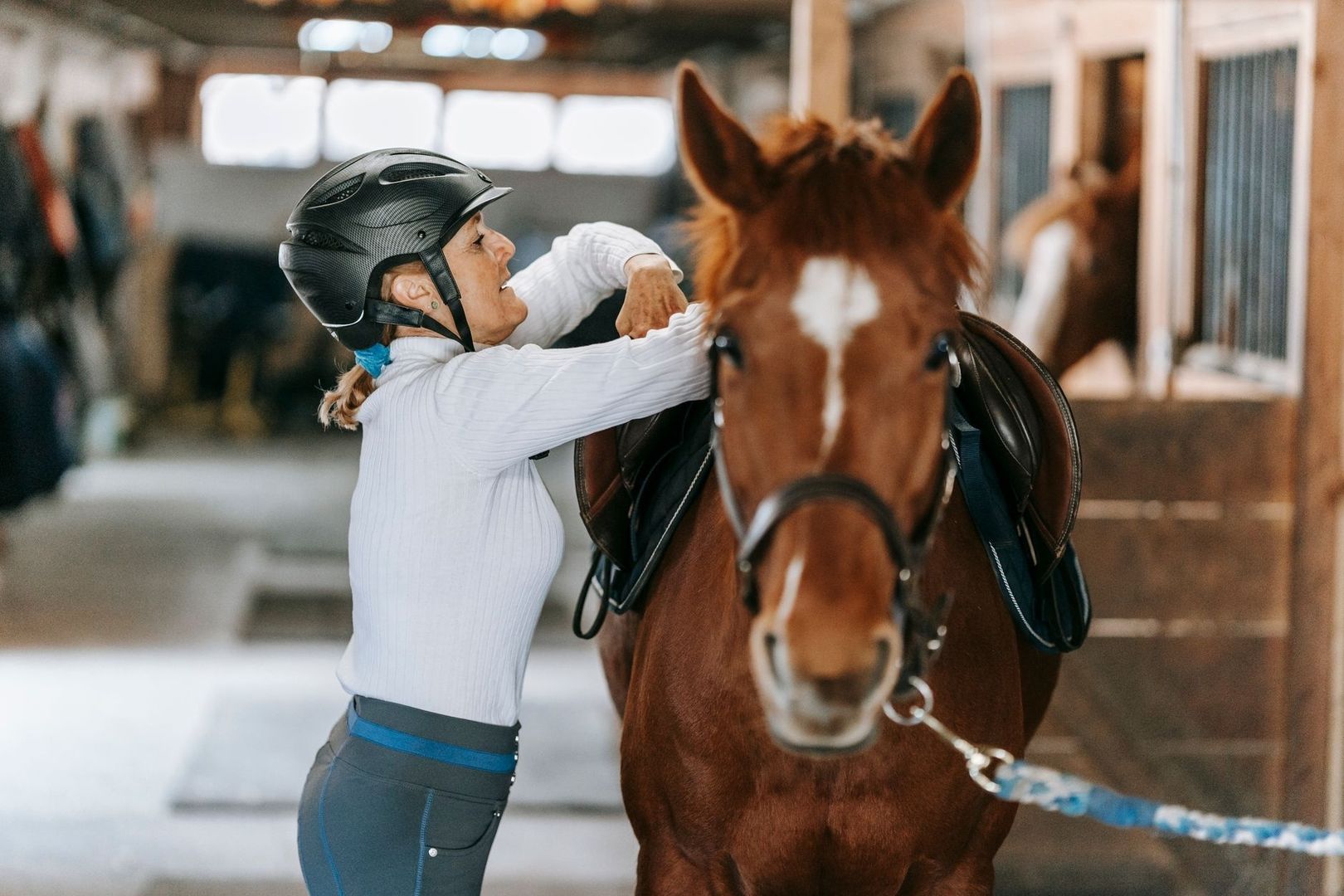
Pay particular attention to the trapezius at the front of the saddle and the longissimus dorsi along the back. These muscles need room to function as the horse lifts and swings the spine. Bunched flocking, hard spots, an uneven panel, or a collapsed cushion can create concentrated pressure. Bridging occurs when the saddle contacts strongly at the front and rear but fails to bear evenly through the middle. Rocking occurs when the saddle tips or moves under the rider, repeatedly loading different pressure points with each stride.
- Place the saddle without a pad and check that the front edge does not sit on the shoulder blade or restrict its backward rotation.
- Run a flat hand beneath the panels and note gaps, abrupt pressure changes, or areas where contact feels unusually firm.
- Check the gullet from front to back, confirming that the channel remains clear of the dorsal spinous processes.
- Girth the saddle normally and observe whether it pulls forward, slides sideways, or sits behind the horse’s natural balance point.
- Repeat the inspection with the rider mounted, because panel contact and tree balance can change under load.
- After work, inspect sweat marks, dirt patterns, and dry spots, while remembering that sweat patterns alone cannot diagnose pressure.
- Look for repeated rubbing, broken hairs, white hairs, swelling, or sensitivity, and photograph changes so they can be compared over time.
A saddle that is sound in construction can still be wrong for a particular horse, and a recently fitted saddle can change as the horse gains muscle, loses condition, or changes workload. Pads may disguise symptoms by adding bulk rather than correcting the underlying geometry. If the saddle rocks, bridges, or repeatedly creates soreness, stop treating the problem as a training challenge and involve a qualified saddler alongside a veterinarian when pain is suspected. Fit before fashion, and function before flash, are particularly important when the horse’s movement is changing.
Clinical Palpation and Static Warning Signs in the Stable
Palpation should be calm, consistent, and safe. Stand beside the shoulder or hindquarter rather than directly behind the horse, keep the hand flat, and begin with light strokes away from the most sensitive areas. Work gradually down the topline, observing the horse’s facial expression, skin twitch, tail movement, muscle contraction, or attempt to step away. Compare left and right sides, but do not repeatedly press a painful area to obtain a stronger reaction. A defensive response is information, not an invitation to test the horse’s tolerance.
Static posture can provide further clues. A horse with back or hindquarter discomfort may stand unevenly, rest a hind leg unusually often, brace the abdominal wall, or hold the head and neck behind the vertical even when untacked. It may also resist lifting a hind foot, lower the back during grooming, or shift weight when the saddle is brought out. These signs can have several causes, including hoof, limb, muscular, or visceral problems, so they should be recorded rather than interpreted as a diagnosis. Practical veterinary guidance from this Authoritative Source on identifying back pain in horses can help owners organise observations before contacting a veterinarian.
- Note the exact location and intensity of any reaction, without forcing flexion or deep pressure.
- Record whether sensitivity appears before exercise, after exercise, or only when tack is applied.
- Check for heat, swelling, skin damage, girth rubs, or changes in muscle shape.
- Stop riding and seek veterinary advice promptly if pain is severe, sudden, associated with lameness, or accompanied by unsafe behaviour.
Build a Proactive Diagnostic Routine for Your Horse
The practical shift is simple but important: replace the immediate disciplinary reaction with a repeatable observation routine. Watch the horse in hand, on both reins, and under saddle when safe. Keep notes on stride length, transitions, posture, tail activity, mounting behaviour, and the point at which the response appears. A short video can be more useful than a general description, especially when the asymmetry is subtle or intermittent.
Maintenance should involve both tack and veterinary oversight. Arrange saddle inspections whenever the horse’s shape or workload changes, and do not wait for obvious rubbing or bucking before checking fit. Pair that review with regular hoof care, dental care, conditioning adjustments, and veterinary evaluation when movement or behaviour changes. A horse that is comfortable is easier to train, safer to ride, and more capable of developing strength. Listening early is not permissive horsemanship; it is sound management, sound saddlery, and responsible advocacy for the animal carrying the rider.
- Record baseline movement during ordinary walk, trot, and transitions.
- Check saddle balance, panel contact, girthing, and post-ride skin and hair patterns.
- Reassess promptly after any fall, sudden behaviour change, or altered training demand.
- Use qualified veterinary and saddlery professionals when pain or fit problems remain possible.