Why Subtle Bridle Pressure Shapes Equine Performance
A well-made bridle should do more than look balanced on the horse’s head. Its job is to communicate clearly while avoiding unnecessary pressure on skin, muscle, cartilage, bone, and the nerves that run close beneath the surface. That requires moving beyond cosmetic symmetry. A crownpiece can sit perfectly level and still press on the wrong structure, while a browband can appear generous yet draw the headpiece forward into the sensitive base of the ears. In practical saddlery, function comes before flash: the leather, padding, stitching, and hardware must all work with the horse’s cranial anatomy.
Small changes in leather placement can have surprisingly large effects. A few millimetres at the cheekpiece, browband, or poll may alter where force is concentrated, particularly when the bridle is tightened or the horse moves into contact. Resistance is therefore not automatically a training problem. Head tossing, ear pinning, facial rubbing, unusual lip movement, reluctance to accept the bit, mouth opening, or sudden tension can indicate discomfort, including pressure on superficial nerve branches. Before increasing rein aids or correcting the horse more firmly, inspect the bridle with the same care given to a saddle’s bearing surface. A useful starting point is a properly constructed anatomically considered bridle, but no design can replace individual fitting.
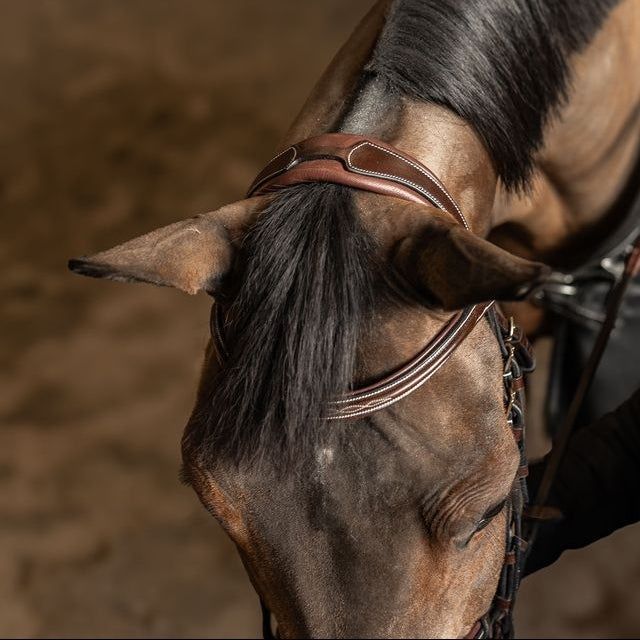
Mapping Cranial Nerves Around the Equine Head
The trigeminal nerve, also called cranial nerve V, supplies much of the sensory information from the horse’s face. Its branches extend across the forehead, around the eye, over the cheeks, and toward the muzzle, lips, jaw, and chin. An Authoritative Source provides a detailed anatomical reference for these pathways. This is why pressure from a noseband, flash strap, cheekpiece, or bit can be more than a superficial nuisance. Compression may create irritation, altered sensation, or a defensive response, especially when the same area is loaded repeatedly during work.
The facial nerve, cranial nerve VII, has a different principal role. It controls muscles involved in movement of the eyelids, nostrils, lips, and other facial structures. Branches of this nerve pass over or near bony areas where there is little soft tissue protection. Behind the ears, the headpiece also interacts with sensitive cartilage and the nuchal ligament, which contributes to the horse’s ability to move the head and neck freely. Detailed equine cranial nerve mapping shows why apparently minor strap changes deserve serious attention.
Muscular discomfort and neural impingement do not always look the same, although they can overlap. A sore muscle may produce stiffness, reluctance to bend, or a guarded posture that improves with rest and gentle movement. Nerve-related discomfort can be sharper, less predictable, and associated with twitching, sudden head movement, facial asymmetry, rubbing, or avoidance of the bridle itself. These signs are not diagnostic on their own, and research discussed in this Authoritative Source reinforces the need to consider alternative causes. Dental disease, ocular pain, skin conditions, temporomandibular joint problems, bit fit, rider influence, and training history must also be considered.
- The trigeminal nerve carries facial sensation and is relevant around the forehead, cheek, nose, lips, jaw, and chin.
- The facial nerve controls important facial movement and has branches that may be exposed to strap pressure near the ears and cheeks.
- High-risk areas include beneath the cheekbone, behind the ears, along the chin, and around the noseband and flash strap.
- Persistent headshaking, rubbing, or bridling resistance warrants a veterinary assessment rather than repeated tack adjustments alone.
Evaluating Crownpiece Curvature and Poll Pressure Points
The poll is not simply a convenient place to hang the bridle. The nuchal ligament attaches in the region behind the skull and continues along the neck, while the atlas and axis form the upper cervical junction immediately behind the head. These structures contribute to head and neck movement, balance, and posture. A crownpiece that concentrates force at one narrow edge can make the horse shorten the neck, raise the head, resist flexion, or alter the way the shoulders and back move.
Width and padding must be judged together. A broader, shaped headpiece can distribute load, but excessive width may run into the ears or create a firm ridge at the edge. Thick padding can also reduce internal space rather than increase comfort. If the leather base is too narrow, poorly curved, or positioned incorrectly, adding foam merely makes the same pressure point larger and less obvious. A useful bridle is shaped around the ear base and poll, with smooth transitions, flexible leather, and enough adjustment to suit the individual horse’s skull.
Bench testing before fitting is an efficient way to find faults. Lay the crownpiece flat and examine whether the underside has a hard seam, abrupt padding step, exposed buckle, or stiff fold where the poll will carry it. Flex the leather gently and check that the cutback is real rather than a shallow decorative curve. Once fitted, run clean fingers beneath the headpiece, then observe the horse walking, bending, and taking contact. Pressure-sensor research has examined how force behind the ears can influence head carriage and gait, as reported in this clinical pressure analysis.
| Inspection point | What to check | Warning sign |
|---|---|---|
| Crownpiece underside | Even, flexible contact with no hard ridge | A buckle, seam, or edge sitting directly on the poll |
| Ear clearance | Space around the ear base without trapping cartilage | Ear pinning, rubs, or a headpiece pulled into the ears |
| Padding thickness | Padding that distributes force without narrowing the channel | Bulky foam creating a new focal pressure point |
| Movement test | Free head and neck movement at walk and in contact | Shortened neck, repeated head raising, or sudden resistance |
Browband Clearance and the Facial Crest Pinch Zone
The browband is often treated as a decorative measurement, but it controls the forward position of the crownpiece. If it is too short, it pulls the headpiece toward the eyes and into the ear cartilage. That tension can also draw the cheekpieces forward, placing them over the rostral edge of the facial crest, the prominent bony ridge on the side of the face. The problem may be bilateral, meaning both sides are compressed at once, and can become worse when the horse lowers the head or the rider takes contact.
Check that the cheekpieces lie behind the facial crest rather than pressing across its front edge, while still remaining correctly aligned with the bit. The familiar three-finger check is a practical guide for browband length: there should generally be enough room to place three fingers between the browband and the base of the ear without forcing the leather upward. This is not a universal measurement, because skull shape and browband construction vary, but it is a useful warning against a visibly tight browband. The ears should move freely, the crownpiece should remain settled, and no strap should leave a sharp indentation after removal.
- Remove the browband from consideration as a style feature and assess what it does to the crownpiece under tension.
- Look for clearance at both ear bases, not only at the centre of the forehead.
- Check the cheekpieces over the facial crest with the horse standing quietly and again with the head lowered.
- Inspect the skin after work for heat, hair disturbance, rubs, or marks that remain longer than a short settling period.
A Master Saddler Guide to On-Horse Diagnostics
On-horse inspection should be systematic. Begin with clean hands and a quiet horse, then remove the bridle if the horse shows marked pain, panic, or unusual neurological signs. Lightly palpate around the infraorbital nerve exit beneath the eye and along the facial crest, comparing left and right sides without pressing hard. The mental nerve exits near the front of the lower jaw, so the chin strap and noseband must not sit in a way that creates concentrated pressure in this area. These palpations do not diagnose nerve injury, but they can reveal guarding, flinching, heat, swelling, or a clear difference between sides.
Next, examine the complete bridle as a working system. A beautifully shaped crownpiece cannot compensate for a browband that is too short, a noseband that is over-tightened, or cheekpieces that pull the bit upward. Check holes, keepers, stitching, edge finishing, and buckle placement as closely as the advertised anatomical profile. Good craftsmanship should produce smooth, load-bearing transitions rather than a thick pad placed over an unchanged pressure point. If discomfort continues despite careful adjustment, involve a qualified bridle fitter and veterinarian, particularly where headshaking, dental pain, facial sensitivity, or neurological disease is possible.
- Place the crownpiece behind the ears and confirm that the ear cartilage is not folded, trapped, or rubbed by a seam.
- Set the browband so it supports the crownpiece without pulling it forward, then check the three-finger clearance at both sides.
- Position the cheekpieces behind the facial crest and confirm that the bit is stable without forcing the lips or bars.
- Fit the noseband according to its intended design, leaving room for appropriate breathing and avoiding concentrated pressure over the muzzle and chin.
- Walk the horse, ask for gentle flexion, and observe ear movement, jaw activity, head carriage, stride regularity, and willingness to take contact.
- Remove the bridle and inspect the skin, hair, temperature, and pressure marks. Record changes rather than relying on memory.
The word “anatomical” should never end the assessment. It is a design intention, not proof of a correct fit. A generous-looking cutback may still terminate at the wrong point for a particular horse, and a narrow conventional bridle may be comfortable if its straps avoid the relevant structures. Marketing claims deserve to be tested against material quality, adjustability, load distribution, and the horse’s response over several rides. Fit before fashion remains the soundest buying rule.
Transform Your Tack Room Diagnostics Today
Anatomical awareness turns bridle fitting from a visual exercise into a practical welfare check. Understanding where the trigeminal and facial nerves lie helps riders recognise why a small ridge, tight strap, or misplaced buckle can produce a disproportionately strong reaction. Early correction may prevent repeated irritation from becoming an entrenched sensitivity, but persistent signs should never be managed by tack changes alone. Veterinary, dental, saddle-fitting, and training factors may all contribute to the same outward behaviour.
Before the next training ride, place the bridle on a clean bench, inspect its pressure surfaces, and then repeat the check on the horse. Trust tactile feedback over fashion labels, thick padding, or an attractive profile. Look for free ears, an unpinched browband, clear facial crest placement, a balanced noseband, and relaxed movement. A bridle that fits well should disappear into the background of communication, allowing the horse to carry the head and neck without defending against the equipment.
- Check the crownpiece, browband, cheekpieces, and noseband before every significant change in work or equipment.
- Replace or repair leather that has hardened, cracked, stretched unevenly, or developed sharp edges.
- Photograph pressure marks and note behavioural changes so patterns can be discussed accurately with professionals.
- Choose construction that distributes pressure, then refine the fit for the individual horse in front of you.